
Protect Fruit Trees from Rodent Damage

How to Protect Fruit Trees from Rodents
Growing fruit trees is incredibly rewarding, but nothing ruins a harvest faster than an infestation of rats or mice. Rodents are opportunistic foragers, and a fruit-bearing tree provides them with everything they need: food, shelter, and water. Left unchecked, these pests can destroy your crops, damage the root systems, and even kill mature trees.
If you are wondering how to protect fruit trees from rodent damage, you need a proactive, multi-step approach. Here is everything you need to know to keep your orchard healthy, thriving, and rodent-free.
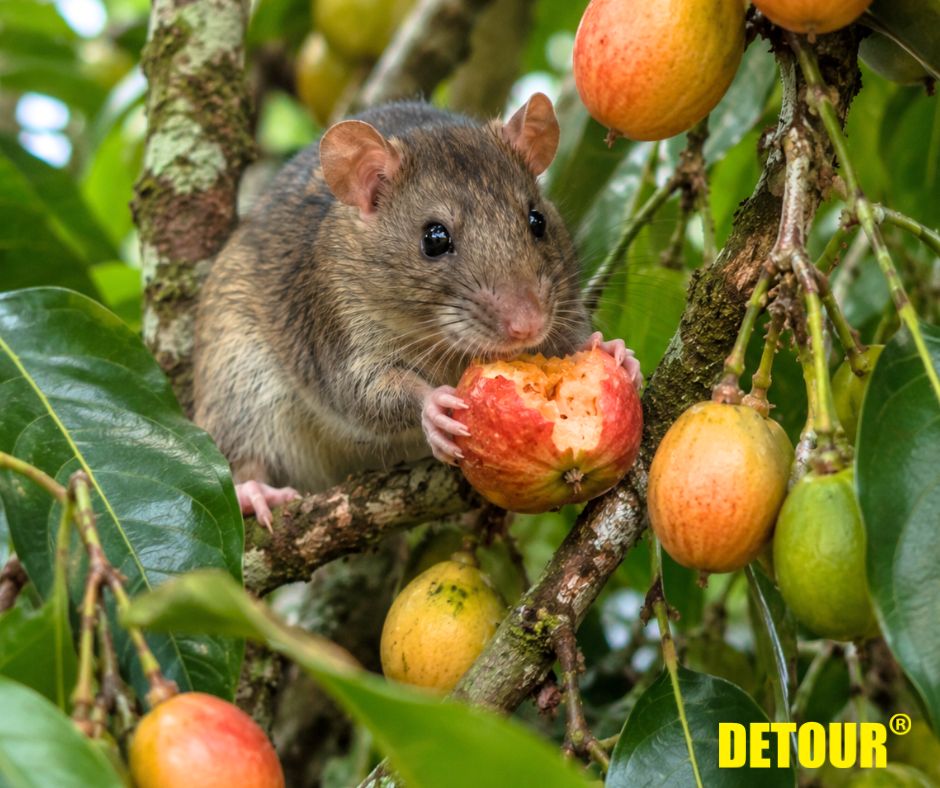
Recognizing Rodent Damage on Fruit Trees
Before you can effectively treat a rodent problem, you need to confirm that rats or mice are the actual culprits. Rodent damage typically presents in a few specific ways:
- Trunk Girdling: This is the most dangerous type of damage. Rodents will chew away the bark around the base of the trunk, especially in winter when other food is scarce. If they chew in a complete circle (girdling), it cuts off the tree’s nutrient supply, effectively killing it.
- Burrowing and Root Damage: Roof rats and Norway rats often dig complex burrows around the base of trees, exposing and chewing on tender roots.
- Partially Eaten Fruit: Finding hollowed-out fruit on the ground or half-eaten fruit still hanging on the lower branches is a classic sign of rat activity.
Best Practices to Keep Rodents Away
Protecting your trees requires making your yard an unappealing environment for pests. Implement these physical and environmental changes to stop rodents in their tracks.
Maintain Impeccable Orchard Hygiene
Sanitation is your first line of defense. Rodents are drawn to easy meals. Make it a daily habit to pick up fallen, bruised, or rotting fruit from the ground. Furthermore, keep the grass around the base of your trees mowed short, and pull any dense weeds. Rodents hate being exposed to predators, so removing tall grass eliminates their hiding spots.
Install Physical Tree Guards
Physical barriers are highly effective at preventing trunk girdling. You can wrap the lower trunk of your fruit trees with hardware cloth (wire mesh) or plastic tree guards.
- Bury the mesh about 2 to 3 inches into the soil to prevent burrowing underneath.
- Extend the guard at least 18 to 24 inches high so rodents cannot simply climb over it.
- Leave a little room between the guard and the trunk to allow the tree to grow.
Proper Pruning Techniques
Roof rats are excellent climbers. If tree branches touch fences, roofs, or the ground, you are essentially providing a ladder straight to your fruit. Prune your trees so the lowest branches are at least two to three feet off the ground, and ensure they do not touch adjacent structures.
Why Traditional Poisons Belong Outside the Orchard
When faced with a rat problem, many gardeners instinctively reach for rodenticides. However, using chemical poisons around fruit trees comes with significant risks.
Feature | Traditional Poisons | Poison-Free Repellents |
Safety | Toxic to pets, wildlife, and children. | Generally safe for surrounding environments. |
Soil Health | Chemicals can leach into the soil. | Biodegradable or environmentally neutral. |
Effectiveness | Rats die, often in hard-to-reach places. | Rats learn to avoid the area entirely. |
Secondary Poisoning | High risk to owls, hawks, and outdoor cats. | Zero risk of secondary poisoning. |
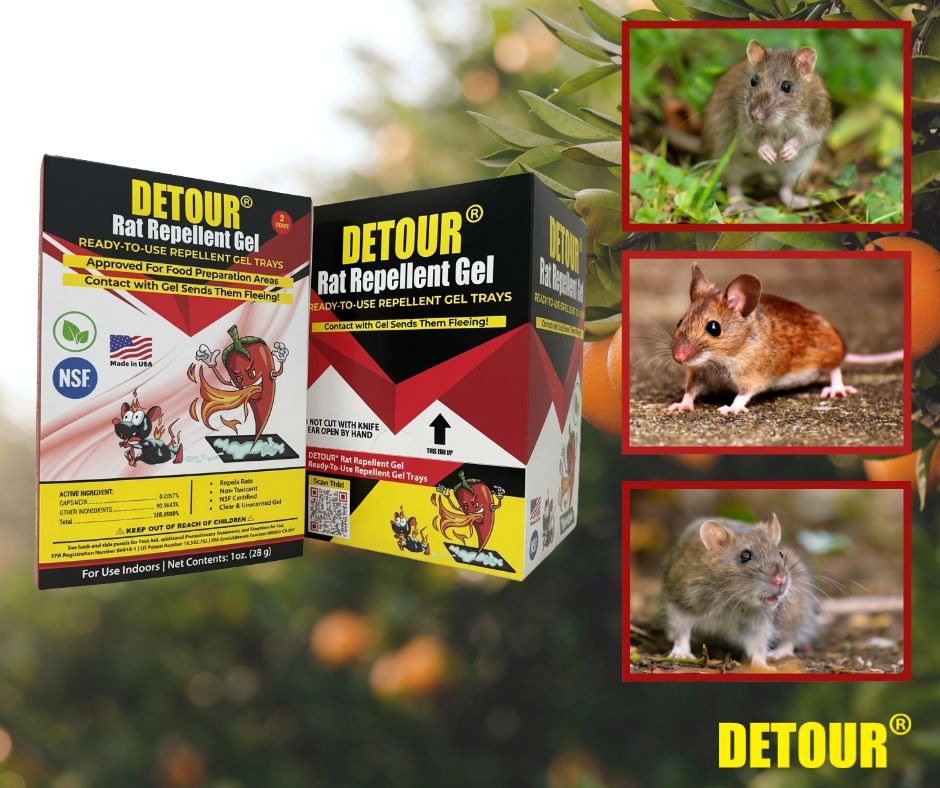
The Ultimate Solution: DETOUR® Rat Repellent
Protect Your Fruit Trees From Rats and Rodent Damage
Protecting your fruit trees from rodent damage doesn’t have to mean resorting to toxic chemicals or constantly replacing dead trees. By maintaining a clean orchard, installing protective mesh guards, and utilizing sensory deterrents, you can secure your harvest for years to come.
Don’t let rats steal the fruits of your labor. Shop DETOUR® Rodent Repellent today and create an impenetrable, poison-free barrier around your garden!

Frequently Asked Questions About Rats and Rodent Damage to Fruit Trees
Q: Why do rats chew car wires?
A: Rats chew car wires because modern auto wiring insulation is often made from soy-based organic materials that attract rodents. Additionally, rats must continuously gnaw on tough materials to trim down their fast-growing incisor teeth, and engine bays provide warm, dark shelter.
Q: Is DETOUR® Wire Protection Gel safe for high-heat engine bays?
A: Yes. DETOUR® Wire Protection Gel features an all-weather formula that retains its viscosity and sticky consistency without melting or evaporating under high engine heat or freezing in extreme winter temperatures.
Q: Will peppermint oil or home remedies stop rats from chewing car wires?
A: Home remedies like peppermint oil or mothballs evaporate rapidly when subjected to engine heat and airflow, offering only temporary deterrence (often lasting less than a few days). A contact bio-repellent like DETOUR® Wire Protection Gel delivers long-lasting protection for up to 12 months.
Q: How long does DETOUR® Wire Protection Gel last after application?
A: When applied directly to non-porous surfaces like automotive wiring, battery cables, and hoses, DETOUR® Wire Protection Gel stays active and effective for up to 3-6 months of outdoor defense and 6-12 months indoors.
Do coffee grounds keep rats away from fruit trees?
While some gardeners claim that strong smells like coffee grounds deter pests, there is no scientific evidence that they effectively repel rats. Hungry rodents will easily ignore coffee grounds to get to fresh fruit. A specialized rat-repellent is a much more reliable solution.
How high can rats jump into fruit trees?
Rats are incredibly agile and can jump up to 3 feet vertically and 4 feet horizontally. This is why it is crucial to keep lower branches pruned and install tree guards that are at least 24 inches tall.
Is DETOUR® RAT Repellent safe to use near edible plants?
Yes. DETOUR® is a poison-free, rat-repellent gel. However, it should be applied to surrounding surfaces, tree guards, or access points rather than directly on the edible fruit or the sensitive bark of the tree.
What time of year is rodent damage worst for fruit trees?
Rodent damage is typically worst during the late fall and winter. When their natural food sources die off in the cold, rats and mice turn to the nutrient-rich bark and roots of fruit trees to survive.